
The recent SNP St Andrews Award Dinner highlighted an important moment of recognition, with David Alexander of Falkirk receiving a lifetime achievement award for his 33 years of dedicated service as a councillor.
His long-standing commitment to both local government and the independence cause exemplifies the kind of experienced leadership that Scottish politics needs. You can watch John Swinney giving the ward.
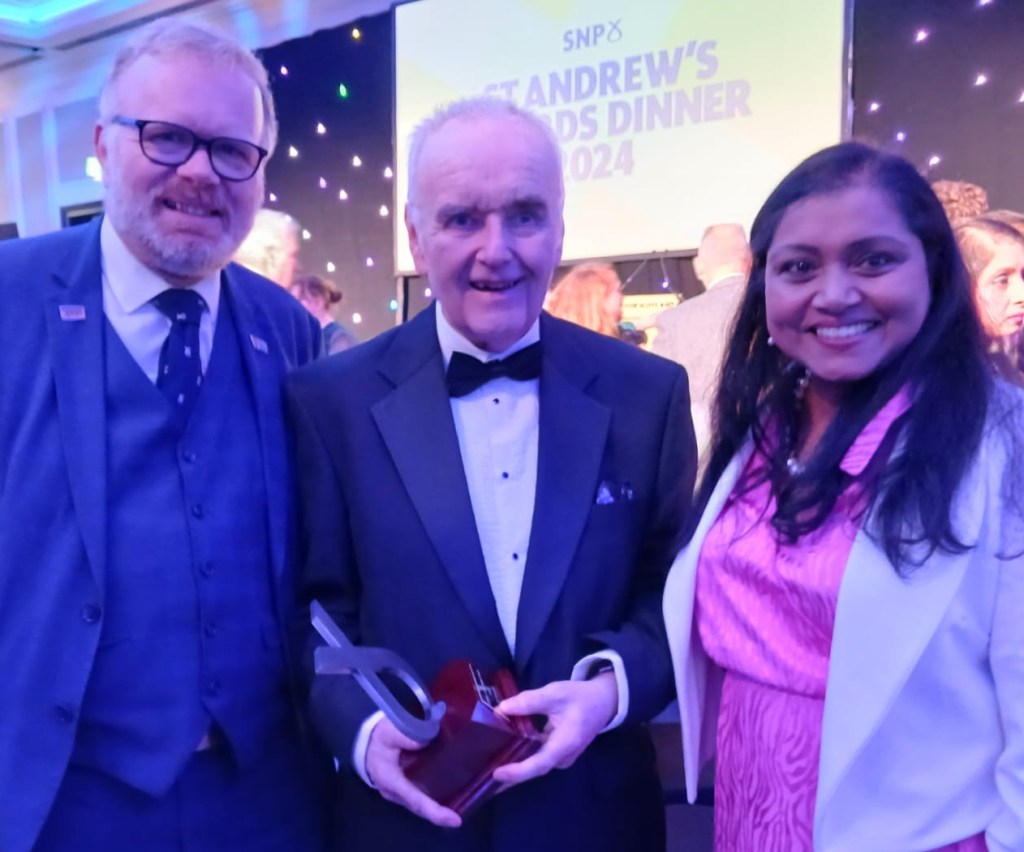
His long-standing commitment to both local government and the independence cause exemplifies the kind of experienced leadership that Scottish politics needs. You can watch John Swinney giving the ward.
This celebration comes at an interesting time, as the issue of dual mandates has recently returned to the spotlight.

SNP Westminster Leader Stephen Flynn’s brief consideration of standing for Holyrood while remaining an MP reignited this long-running debate.
Looking back to 1999, the Scottish Parliament’s establishment saw several MPs successfully transition from Westminster, bringing valuable parliamentary experience to the new institution. This historical precedent was an important one helping the nations focus shift away from Westminster to Scotland
Since then we have lacked a measured approach to managing such transitions – perhaps there should have been a mechanism allowing candidacy while agreeing on an orderly process for stepping down, either at the next election or at a strategically chosen time.
As Scotland continues its constitutional journey, ensuring our best talent can serve in the Scottish Parliament becomes increasingly crucial. A clear, universal approach to dual mandates, combined with sensible transition mechanisms, could help achieve this while maintaining public confidence in our democratic institutions.
Since the Scottish Parliament’s establishment in 1999, 85 MSPs have held dual mandates in various forms.
Most of these cases involved local councillors who briefly retained their council positions while transitioning to Holyrood. However, the more contentious cases have involved simultaneous parliamentary roles. Douglas Ross’s multiple roles as MP, MSP, party leader, and football linesman perhaps best illustrates the challenges of such arrangements. Currently, Labour’s Baroness Clark serves as an MSP while on leave from the House of Lords.
There is no place for unelected Lords in a democracy, the Lords is an institution which needs scrapped and replaced with an elected chamber, or better yet left to England to sort out once Scotland has independence.
The SNP’s relationship with dual mandates has evolved significantly. Alex Salmond was the party’s last dual mandate holder, serving in both Westminster and Holyrood between 2015 and 2016. Subsequently, the party adopted a strict position against dual mandates, requiring MPs to resign before becoming Holyrood candidates. This policy led to Neil Gray’s resignation from Westminster, paving the way for Anum Qaisar’s by-election victory.
However, this SNP-specific restriction has been controversial. Some argue it effectively trapped talent in Westminster and potentially blocked experienced parliamentarians like Joanna Cherry from making the transition to Holyrood in 2021. The policy may have inadvertently hindered the party’s ability to deploy its most experienced politicians where they could be most effective. Other Parties were not so restricted.
The landscape is now changing with Tory MSP Graham Simpson’s amendment to the Scottish Elections Bill, supported by Labour and the Greens. This would create a universal prohibition on dual mandates, aligning Scotland with Wales and Northern Ireland’s approach. This cross-party solution could provide a more balanced way forward.
The proposed national ban on dual mandates appears to be the way forward, but it should be accompanied by thoughtful provisions for managing transitions between parliaments. After all, the goal should be to ensure Scotland’s democratic institutions have access to the best possible talent while maintaining clear lines of accountability and representation.
This evolving debate reflects broader questions about how we structure our democracy to best serve Scotland’s future. What’s your view on dual mandates? How can we best ensure our parliamentary talent is deployed where it can make the most difference?

 Aye Matters